

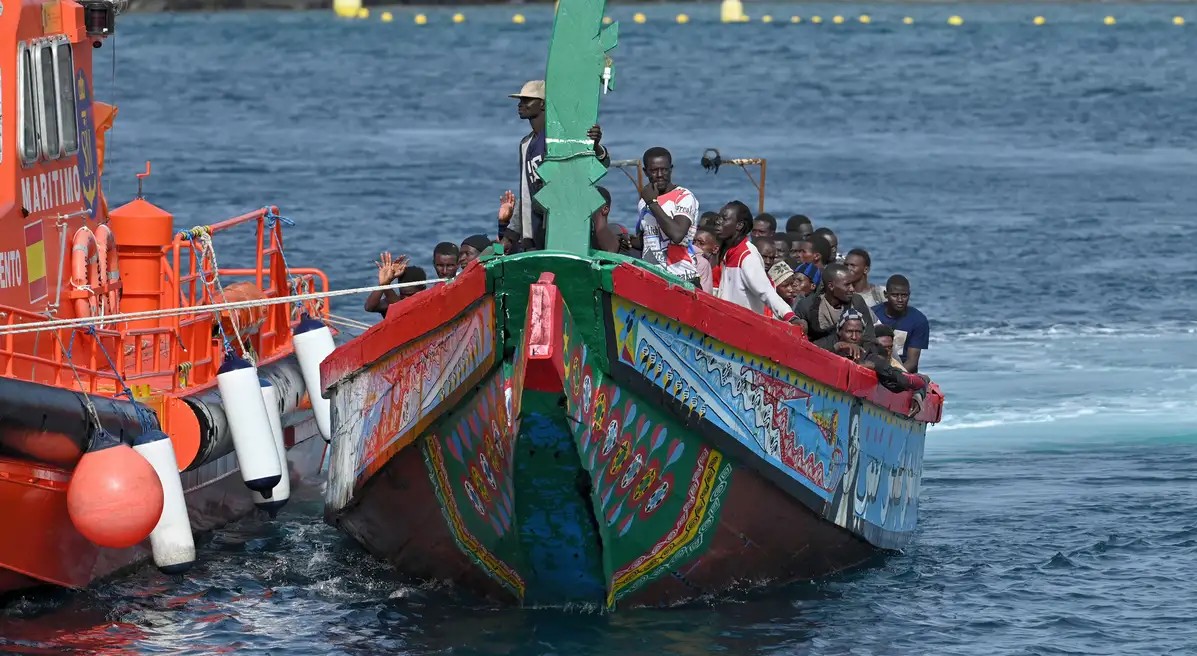
One border, many journeys: Migrants, Refugees and Asylum Seekers
If you are tasked with asking ten people what separates migrants from refugees, there is a high likelihood you will get ten different answers, and the distinction is far from academic. UNHCR explains that refugees are defined and protected by international law, including the 1951 Refugee Convention (UNHCR, 1951) and the 1969 OAU Convention (UNHCR, 1969), while migrants are generally recognized under each country’s own immigration rules.
The blog takes inspiration from the journal titled “Childhood Experiences, Self-Efficacy, and Migration Aspirations Among African Youth: A Systematic Review and Meta-Analysis” by Asare, Agyemang, Addaney and Asante. The authors look at one central question: How do young Africans come to want to leave their home country at all?
Where the journey begins
The authors compiled and reviewed evidence from 68 studies, using 42 for meta-analysis. They found that the unfavourable childhood experiences, such as economic hardship, parental absence and educational disruption, were associated with stronger migration aspirations (1.67). In plain terms, young people who reported having more childhood adversities had about 67% odds of aspiring to migrate than those who reported facing less adversities (Asare, Agyemang, Addaney, & Asante, 2026 , p. 58). By contrast, children who experienced stable caregiving, schooling and mentorship were associated with weaker aspirations, with an odds ratio of 0.58 or roughly 42% lower odds (Asare, Agyemang, Addaney, & Asante, 2026 , p. 65). Having a migrant parent abroad showed the strongest link, which the authors interpret as migration becoming an accepted way of making a living in which the sentiment to migrate is passed down within families seeking better opportunities and lifestyles.
When looking at some stories, the authors state that exposure to migration narratives from family, peers and social media was associated with stronger aspiration, especially among the youths with moderate self-efficacy, because success stories suggest that migration is achievable. They also add that platforms tend to circulate curated successes while filtering out failures and qualitative studies in the report found that aspirations start forming before the age of 15 and persist even after young people learned about the risk (Asare, Agyemang, Addaney, & Asante, 2026 , pp. 67 - 68).
What governments are weighing
The authors note that irregular migration is still a huge attraction for young Africans despite deterrence efforts and risk awareness campaigns. Irregular movement toward Europe through the Central Mediterranean Route has been a center of attention, with the IOM documenting over 28,000 recorded deaths on this route since 2014, underscoring the risks associated with irregular movement (IOM, 2014-2023). Authorities hence have a humanitarian and security reason to discourage dangerous crossings. Yet the pressure on governments is not limited to the border: about 65% of refugees and others needing international protection live in a country next to their own (UNHCR, 2025), so much of the responsibility for hosting displaced people falls on neighbouring governments.
The authors observed that Ghana is neither affected by conflict nor economic collapse, yet for some reason irregular immigration persists, which in turn suggests that crises alone cannot explain why people leave and seek refuge. It is also clear that the African Union’s 2018 migration framework already acknowledges that tackling migration requires attention to youth opportunity and developmental pathways.
Beyond “Us versus Them”
It is tempting to frame the migration debate as governments against migrants. The evidence suggests a shared problem. States want a safe, orderly movement and manageable asylum systems and on the other side, people on the move want safety, dignity and a fair chance at a future. The authors conclude that young people’s desire to migrate reflect their individual agency to seek a better and sustainable life, it should not be viewed as a problem. They argue that the real goal of policy is to make sure that young people’s aspirations are molded by informed decisions, whether they decide to stay or leave , and that those who migrate should do so safely.
Whether someone is a migrant, a refugee or an asylum seeker, the test for good policy is the same: does it protect lives, respect people’s agency and address the conditions that start journeys long before the border?
References
Asare, S. E., Agyemang, E. A., Addaney, M., & Asante, K. T. (August 31 , 2026 ). “Childhood Experiences, Self-Efficacy, and Migration Aspirations Among African Youth: A Systematic Review and Meta-Analysis. Mimupada lati SIHMA: https://sihma.org.za/storage/journals/3.%20Childhood%20Experiences,%20Self-Efficacy,%20and%20Migration%20Aspirations%20Among%20African%20Youth.pdf
IOM. (2014-2023). A Decade of Deaths and Disappearances During Migration Worldwide. Mimupada lati IOM: https://missingmigrants.iom.int/decade-deaths-and-disappearances-during-migration-worldwide
UNHCR. (1951). The 1951 Refugee Convention. Mimupada lati UNHCR: https://www.unhcr.org/about-unhcr/overview/1951-refugee-convention
UNHCR. (September 10 , 1969). OAU Convention Governing the Specific Aspects of Refugee Problems in Africa, adopted by the Assembly of Heads of State and Government at its Sixth Ordinary Session. Mimupada lati UNHCR: https://www.unhcr.org/media/oau-convention-governing-specific-aspects-refugee-problems-africa-adopted-assembly-heads
UNHCR. (2025). Global Trends report 2025. Mimupada lati UNHCR: https://www.unhcr.org/media/global-trends-report-2025
Categories:
Tags:
- Asare Agyemang Addaney And Asante
- Asylum Seekers
- Policy Making
- Sustainable Life
- Individual Agency
- African Union Migration Framework
- Refugee Protection
- International Organization For Migration
- Central Mediterranean Route
- Irregular Migration
- Social Media Influence
- Migration Narratives
- Stable Caregiving
- Educational Disruption
- Parental Absence
- Economic Hardship
- Systematic Review And Meta Analysis
- Migration Aspirations
- Self Efficacy
- Childhood Experiences And Migration
- African Youth Migration
- 1969 OAU Convention
- 1951 Refugee Convention
- International Law
- Migrants Versus Refugees